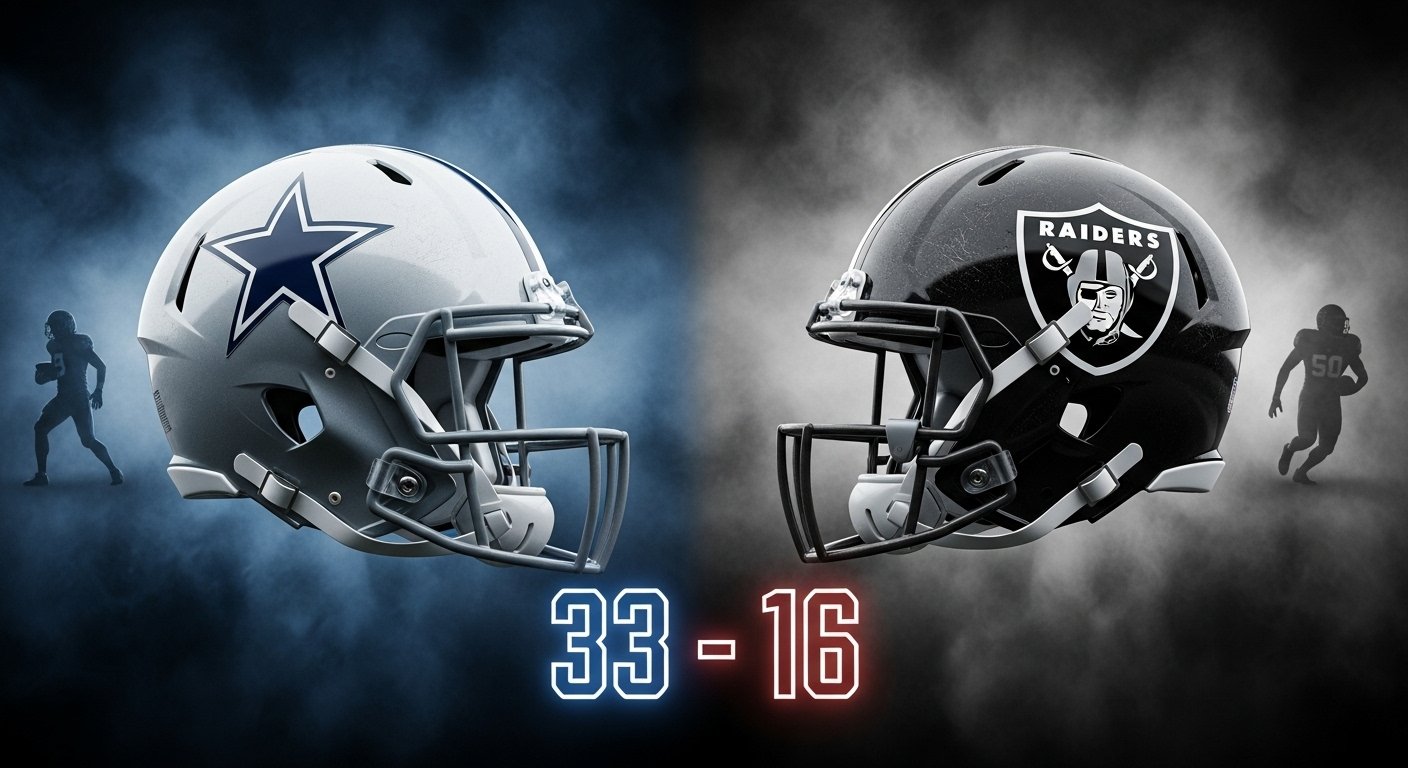
Dallas Cowboys vs Las Vegas Raiders Match Player Stats (Nov 17, 2025)
The Dallas Cowboys defeated the Las Vegas Raiders 33 to 16 on Monday Night Football at Allegiant Stadium in Las Vegas on November 17, 2025.
Dak Prescott threw four touchdown passes without an interception, completing 25 of 33 attempts for 268 yards in his Monday Night Football performance. George Pickens caught nine passes for 144 yards and a touchdown, setting a franchise record pace with 908 yards through 10 games.
Dallas held the Raiders to just 27 rushing yards while generating four sacks. Geno Smith completed 27 of 42 passes for 238 yards with one touchdown and one interception, taking four sacks behind a struggling offensive line.
Table of Contents
Game Context and Significance
The Cowboys played their first game since the death of defensive end Marshawn Kneeland on November 6. The 24 year old was found dead of an apparent suicide during the bye week. Head coach Brian Schottenheimer and players wore shirts honoring Kneeland before kickoff. A moment of silence preceded the game.
“They wanted to honor him, and we’re not done honoring him,” Schottenheimer said after the victory. “He’s a part of our family forever. But it’s been tough, man. I mean, these past 11 days have been really tough. I’m proud of those guys because just the way they played today, they played with Marshawn’s play style.”
Team owner Jerry Jones credited Schottenheimer’s leadership during an emotionally difficult period. “They know how much that Marshawn loved to compete, how much he loved the Cowboys. And to me, it’s just a way of saying, ‘This one’s for you, Marshawn.'”
The game carried playoff implications for Dallas. Entering this Week 11 matchup at 3-5-1, the Cowboys needed wins to stay relevant in the NFC East race. For Las Vegas at 2-7, the season had already slipped away under first year head coach Pete Carroll.
Quick Stats Summary
- Dallas controlled possession 33:36 to 26:24 and averaged 5.9 yards per play
- Cowboys converted 60% of red zone opportunities, Raiders just 25%
- Quinnen Williams generated 5 quarterback pressures in his Cowboys debut
- Schottenheimer benched CeeDee Lamb and George Pickens for the opening series
- Dallas scored touchdowns on five consecutive possessions spanning 21 minutes
Game Leaders
| Category | Cowboys Leader | Stats | Raiders Leader | Stats |
|---|---|---|---|---|
| Passing | D. Prescott | 25/33, 268 Yds, 4 TD | G. Smith | 27/42, 238 Yds, 1 TD |
| Rushing | J. Williams | 22 Car, 93 Yds | G. Smith | 4 Car, 14 Yds |
| Receiving | G. Pickens | 9 Rec, 144 Yds, 1 TD | B. Bowers | 7 Rec, 72 Yds |
| Sacks | Q. Williams | 1.5 Sacks | M. Crosby | 1.0 Sack |
| Tackles | D. Bland | 10 (6 Solo) | D. White | 10 (3 Solo) |
Scoring Summary
| Team | Q1 | Q2 | Q3 | Q4 | Final |
|---|---|---|---|---|---|
| Dallas Cowboys | 3 | 21 | 7 | 2 | 33 |
| Las Vegas Raiders | 6 | 3 | 0 | 7 | 16 |
Attendance: 62,625
Team Statistics
| Category | Dallas | Las Vegas |
|---|---|---|
| Total Yards | 381 | 236 |
| First Downs | 24 | 17 |
| Passing Yards | 267 | 209 |
| Rushing Yards | 114 | 27 |
| Third Down | 4/10 (40%) | 3/12 (25%) |
| Fourth Down | 1/3 (33%) | 2/3 (67%) |
| Red Zone | 3/5 (60%) | 1/4 (25%) |
| Penalties | 6-50 | 6-40 |
| Turnovers | 1 | 1 |
| Time of Possession | 33:36 | 26:24 |
Dallas averaged 5.9 yards per play while Las Vegas managed just 4.1. The Cowboys ran 65 total plays compared to the Raiders’ 58. ESPN’s complete box score shows the decisive advantage Dallas held in nearly every statistical category.
Quarterback Breakdown
| Stat | Dak Prescott (DAL) | Geno Smith (LVR) |
|---|---|---|
| Completions/Attempts | 25/33 | 27/42 |
| Completion % | 75.8% | 64.3% |
| Passing Yards | 268 | 238 |
| Yards Per Attempt | 8.1 | 5.7 |
| Touchdowns | 4 | 1 |
| Interceptions | 0 | 1 |
| Sacks Taken | 1 (1 yard) | 4 (29 yards) |
| Passer Rating | 138.6 | 77.3 |
| QBR | 86.6 | 19.8 |
Prescott faced pressure on just 20.6% of his dropbacks, the second lowest rate he has seen this season. From a clean pocket, he completed 22 of 27 passes for 256 yards and all four touchdowns. That protection allowed him to exploit Las Vegas’ secondary with precision timing routes and play action concepts. His four touchdown performance gave him 41 career games with three or more touchdown passes, breaking Tony Romo’s franchise record of 40.
Smith faced constant pressure from a Cowboys defensive front that generated 31 total pressures. The Raiders quarterback averaged just 5.7 yards per attempt. Kenneth Murray tipped Smith’s second quarter pass, which Markquese Bell intercepted at the Dallas 31.
Rushing Performance
Dallas Cowboys
| Player | Position | Carries | Yards | Average | TD | Long |
|---|---|---|---|---|---|---|
| Javonte Williams | RB | 22 | 93 | 4.2 | 0 | 16 |
| Malik Davis | RB | 4 | 20 | 5.0 | 0 | 9 |
| Hunter Luepke | FB | 1 | 5 | 5.0 | 0 | 5 |
| Dak Prescott | QB | 4 | -4 | -1.0 | 0 | 0 |
| Team Total | 31 | 114 | 3.7 | 0 | 16 |
Las Vegas Raiders
| Player | Position | Carries | Yards | Average | TD | Long |
|---|---|---|---|---|---|---|
| Geno Smith | QB | 4 | 14 | 3.5 | 0 | 7 |
| Ashton Jeanty | RB | 6 | 7 | 1.2 | 0 | 11 |
| Raheem Mostert | RB | 2 | 6 | 3.0 | 0 | 4 |
| Team Total | 12 | 27 | 2.3 | 0 | 11 |
Williams’ 22 carries represented his highest workload of the season. The Cowboys established offensive balance early, running 31 times compared to the Raiders’ 12 attempts. That commitment to the ground game kept Dallas ahead of the chains on early downs and set up manageable third down distances.
Dallas limited the Raiders to just 27 rushing yards, matching the fewest they have allowed this season. Jeanty, the sixth overall pick in the 2025 draft, received only six carries. Pete Carroll’s offense attempted 42 passes against 12 runs, abandoning the ground game completely. Similar issues plagued Las Vegas in their previous game against Denver, where offensive line injuries disrupted their ability to establish any rushing attack.
Receiving Performance
Dallas Cowboys
| Player | Position | Targets | Receptions | Yards | Average | TD | Long |
|---|---|---|---|---|---|---|---|
| George Pickens | WR | 11 | 9 | 144 | 16.0 | 1 | 37 |
| CeeDee Lamb | WR | 7 | 5 | 66 | 13.2 | 1 | 23 |
| Hunter Luepke | FB | 3 | 3 | 36 | 12.0 | 0 | 15 |
| Jake Ferguson | TE | 5 | 4 | 16 | 4.0 | 1 | 7 |
| Ryan Flournoy | WR | 1 | 1 | 2 | 2.0 | 1 | 2 |
| Brevyn Spann-Ford | TE | 1 | 1 | 4 | 4.0 | 0 | 4 |
| KaVontae Turpin | WR | 2 | 1 | 0 | 0.0 | 0 | 0 |
| Javonte Williams | RB | 1 | 1 | 0 | 0.0 | 0 | 0 |
Las Vegas Raiders
| Player | Position | Targets | Receptions | Yards | Average | TD | Long |
|---|---|---|---|---|---|---|---|
| Brock Bowers | TE | 12 | 7 | 72 | 10.3 | 0 | 18 |
| Tre Tucker | WR | 8 | 4 | 47 | 11.8 | 1 | 26 |
| Tyler Lockett | WR | 3 | 3 | 33 | 11.0 | 0 | 15 |
| Ashton Jeanty | RB | 8 | 6 | 27 | 4.5 | 0 | 8 |
| Ian Thomas | TE | 1 | 1 | 20 | 20.0 | 0 | 20 |
| Jack Bech | WR | 1 | 1 | 19 | 19.0 | 0 | 19 |
| Michael Mayer | TE | 4 | 3 | 13 | 4.3 | 0 | 8 |
| Raheem Mostert | RB | 2 | 2 | 7 | 3.5 | 0 | 4 |
Pickens accumulated 144 receiving yards with 77 coming after the catch, demonstrating his ability to create yards after contact and break tackles. Dallas Cowboys official statistics confirm his 908 receiving yards through 10 games set a franchise record for most yards in a player’s first 10 games with the team.
Schottenheimer benched both Lamb and Pickens for the opening offensive series as a disciplinary decision. Once they entered the game on Dallas’ second possession, the offense scored touchdowns on five consecutive drives spanning from 14:51 of the second quarter through 6:19 of the third quarter.
Bowers led Las Vegas with seven catches on 12 targets but couldn’t reach the end zone. Smith leaned heavily on checkdowns and short targets as pressure prevented routes from developing downfield. Tucker’s six yard touchdown catch in the fourth quarter provided the Raiders’ only offensive score.
Defense
Dallas Cowboys
| Player | Position | Tackles | Solo | Sacks | TFL | QB Hits | PD | INT |
|---|---|---|---|---|---|---|---|---|
| DaRon Bland | CB | 10 | 6 | 0 | 0 | 0 | 2 | 0 |
| Shemar James | LB | 7 | 3 | 0 | 0 | 0 | 0 | 0 |
| Marist Liufau | LB | 7 | 2 | 0 | 0 | 0 | 0 | 0 |
| Donovan Ezeiruaku | ED | 5 | 3 | 0 | 2 | 0 | 0 | 0 |
| Quinnen Williams | DT | 4 | 1 | 1.5 | 1 | 5 | 0 | 0 |
| Malik Hooker | S | 3 | 3 | 0 | 1 | 0 | 1 | 0 |
| James Houston | ED | 2 | 1 | 1.0 | 1 | 1 | 0 | 0 |
| Kenny Clark | DT | 2 | 1 | 0.5 | 1 | 1 | 0 | 0 |
| Osa Odighizuwa | DT | 1 | 1 | 1.0 | 1 | 3 | 0 | 0 |
| Markquese Bell | S | 1 | 0 | 0 | 0 | 0 | 2 | 1 |
Las Vegas Raiders
| Player | Position | Tackles | Solo | Sacks | TFL | QB Hits | PD | INT |
|---|---|---|---|---|---|---|---|---|
| Devin White | LB | 10 | 3 | 0 | 0 | 1 | 0 | 0 |
| Isaiah Pola-Mao | S | 9 | 4 | 0 | 0 | 0 | 0 | 0 |
| Jeremy Chinn | S | 6 | 2 | 0 | 0 | 0 | 0 | 0 |
| Maxx Crosby | ED | 5 | 3 | 1.0 | 1 | 2 | 0 | 0 |
| Kyu Blu Kelly | CB | 5 | 3 | 0 | 0 | 0 | 0 | 0 |
| Adam Butler | DT | 5 | 1 | 0 | 0 | 0 | 0 | 0 |
| Thomas Booker IV | DT | 5 | 1 | 0 | 0 | 0 | 1 | 0 |
| Elandon Roberts | LB | 4 | 2 | 0 | 0 | 0 | 0 | 0 |
| Jamal Adams | LB | 4 | 1 | 0 | 0 | 0 | 0 | 0 |
| Tyree Wilson | ED | 3 | 2 | 0 | 1 | 1 | 0 | 0 |
Quinnen Williams made an immediate impact in his first game with Dallas. The Cowboys acquired him at the trade deadline from the Jets for a 2027 first round pick, a 2026 second rounder, and defensive tackle Mazi Smith. Playing just 33 snaps in his debut, Williams generated five quarterback pressures and 1.5 sacks despite facing 14 double teams. That 17.9% pressure rate on limited snaps validated the steep price Dallas paid.
Bland bounced back from a difficult performance against Arizona in Week 9, leading the team with 10 tackles while breaking up two passes. Bell’s interception came at a critical moment in the second quarter when the game remained close at 10 to 6.
The Raiders defense faced 65 offensive plays while their own offense ran just 58. The unit wore down as the game progressed, unable to get off the field on third downs. Crosby’s strip sack of Prescott on Dallas’ second possession gave Las Vegas excellent field position, but the defense couldn’t capitalize with stops when the offense failed to sustain drives.
Special Teams
Kicking
| Player | Team | FG Made/Att | Long | XP Made/Att | Points |
|---|---|---|---|---|---|
| Brandon Aubrey | DAL | 1/1 | 50 | 4/4 | 7 |
| Daniel Carlson | LVR | 3/3 | 45 | 1/1 | 10 |
Punting
| Player | Team | Punts | Yards | Average | Inside 20 | Long |
|---|---|---|---|---|---|---|
| Bryan Anger | DAL | 2 | 93 | 46.5 | 1 | 49 |
| AJ Cole | LVR | 3 | 160 | 53.3 | 1 | 64 |
Returns
| Player | Team | Type | Returns | Yards | Average | Long |
|---|---|---|---|---|---|---|
| KaVontae Turpin | DAL | Kickoff | 4 | 111 | 27.8 | 39 |
| KaVontae Turpin | DAL | Punt | 1 | 14 | 14.0 | 14 |
| Dylan Laube | LVR | Kickoff | 4 | 94 | 23.5 | 27 |
| Raheem Mostert | LVR | Kickoff | 2 | 42 | 21.0 | 23 |
| Tre Tucker | LVR | Punt | 2 | 4 | 2.0 | 7 |
Dallas won the field position battle throughout Monday night. Turpin averaged 27.8 yards on four kickoff returns, consistently giving the Cowboys favorable starting field position. His 39 yard return in the first quarter set up a promising drive that resulted in Aubrey’s 50 yard field goal.
Cole’s punting kept Dallas pinned deep on multiple occasions, with his 64 yard boot in the third quarter flipping field position. When the Cowboys did punt, Anger averaged 46.5 yards and placed one inside the 20, limiting the Raiders’ ability to mount comeback drives with short fields.
Carlson converted all three field goal attempts from 35, 45, and 38 yards, providing the Raiders’ only scoring in the first half. Despite his perfect night, Las Vegas settled for field goals on drives that needed touchdowns. The special teams advantage directly contributed to Dallas scoring opportunities, with three of their five scoring drives starting beyond their own 30 yard line.
How Dallas Dominated
First Quarter: Both teams traded field goals through the opening 15 minutes. Maxx Crosby strip sacked Prescott on Dallas’ second possession, with Tonka Hemingway recovering at the Cowboys 15. The Raiders settled for a field goal to take a 6 to 3 lead. Schottenheimer benched Lamb and Pickens for the opening series as a disciplinary decision.
Second Quarter Explosion: Dallas scored 21 unanswered points once their star receivers entered the game. Prescott connected with Lamb for 18 yards at 14:51 to give the Cowboys their first lead. A methodical 12 play, 79 yard drive ended with Ferguson’s five yard touchdown catch at 5:16. Bell’s interception set up Pickens’ 37 yard touchdown at 1:10, extending the lead to 24 to 6. Carlson’s 38 yard field goal before halftime made it 24 to 9.
The turning point came on Bell’s interception. With the score 10 to 6 and momentum still uncertain, Kenneth Murray tipped Smith’s pass at the Dallas 31. Four plays later, Pickens caught a quick slant, made two defenders miss, and raced untouched to the end zone. The Cowboys never trailed again.
Third Quarter Control: Dallas opened the second half with a 12 play, 80 yard drive consuming over seven minutes. Prescott hit Flournoy from two yards out at 6:19 to make it 31 to 9. The Raiders managed just 62 yards in the quarter without scoring. Their inability to sustain drives kept the Cowboys defense fresh while wearing down Las Vegas’ own defensive unit.
Fourth Quarter Formalities: Tucker’s six yard touchdown reception at 13:22 cut the deficit to 31 to 16, but a failed two point conversion kept it a two score game. Dallas punted for the first time all night on their next possession. Bryan Anger’s 49 yard punt pinned the Raiders at their own two yard line. On the first play from scrimmage, Donovan Ezeiruaku and DaRon Bland combined to tackle Jeanty in the end zone for a safety at 11:39. The Cowboys ran out the clock after Las Vegas turned it over on downs with 2:31 remaining.
Why Did the Cowboys Win This Game?
Dallas established offensive balance that Las Vegas couldn’t match. Running 31 times kept the Raiders defense honest and allowed Prescott to attack from play action and clean pockets. With pressure on just 20.6% of dropbacks, Prescott had time to work through his progressions and exploit defensive breakdowns.
Schottenheimer’s decision to bench Lamb and Pickens for the opening series proved brilliant. Both players responded by dominating once they entered. The message about accountability resonated, and the team scored on five consecutive possessions afterward.
Quinnen Williams transformed the Cowboys pass rush in his first game. Collapsing the pocket from the interior created one on one matchups on the edge that Houston, Odighizuwa, and others capitalized on. The Raiders offensive line, already struggling with injuries, couldn’t handle the new dimension Dallas added at the trade deadline.
Why Did the Raiders Lose?
Pete Carroll’s decision to throw 42 passes against just 12 runs abandoned any pretense of offensive balance. With Jeanty limited to six carries, defenses could focus entirely on pass rush. The same approach failed against Denver in Week 10, yet the Raiders repeated it on national television.
NFL.com reported Las Vegas became only the third team since at least 1991 with 30 or more dropbacks and four or fewer runs in a first half. The four rushes matched their second fewest in any first half since that year.
The offensive line couldn’t protect Smith. Missing both starting guards from their previous game, the makeshift unit allowed four sacks and 31 total pressures. Smith rarely had time to let routes develop, forcing him into checkdowns and quick throws that gained minimal yardage.
Red zone failures killed any chance at a comeback. Converting just one of four trips inside the Dallas 20 into a touchdown meant settling for field goals when touchdowns were needed. The Cowboys scored touchdowns on three of five red zone opportunities, a difference that proved insurmountable.
Playoff and Season Implications
Dallas improved to 4-5-1 heading into a critical Week 12 home game against the Philadelphia Eagles on November 23. The defending Super Bowl champions lead the NFC East. The Cowboys trail by three games with seven remaining.
The Cowboys’ playoff situation remains uncertain. A loss to Philadelphia would essentially eliminate Dallas from division contention, shifting focus to wild card positioning where they currently sit two games behind the seventh seed. The Cowboys need to win at least five of their final seven games to reach 10 victories, typically the minimum required for playoff consideration. Games against Kansas City and Detroit follow the Eagles matchup, creating one of the NFL’s toughest remaining schedules.
Prescott’s four touchdown performance and the defense limiting an opponent to 27 rushing yards provide momentum. The trade for Quinnen Williams appears shrewd after his dominant debut. Similar to their overtime comeback victory against the Giants earlier this season, where Brandon Aubrey kicked historic field goals in a 40 to 37 win, Dallas showed resilience under Schottenheimer’s leadership.
Las Vegas sits at the bottom of the AFC West at 2-8. Carroll’s first season leading the franchise has spiraled into a rebuilding year. The Raiders sit just one game ahead of the teams with the worst records in the conference, making draft positioning the primary focus for the final seven weeks.
Brock Bowers continues producing despite the team’s struggles, but underutilizing him in the red zone wastes his talent. Jeanty’s limited carries raise questions about offensive philosophy. Smith faces constant pressure behind an injured offensive line, creating unsustainable conditions for any quarterback.
Cleveland visits Allegiant Stadium on November 23 for another home game. Both teams sit at 2-8, making it a battle with significant draft implications. Another loss would drop Las Vegas to 2-9, effectively ending any faint hopes and accelerating the evaluation process for next season.
The Cowboys controlled both sides of the ball from the opening kickoff to final whistle. Pro Football Reference’s detailed game statistics document how Dallas won the possession battle by over seven minutes, dominated third down conversions, and executed in the red zone when opportunities arose. Schottenheimer’s first season suffered through the tragedy of losing Kneeland, but the team responded with focused, physical football that honored their fallen teammate’s approach to the game.